Flat Fee vs AUM | Part 1: Why We Strongly Believe a Flat Fee Is In the Best Interest of Our Clients

If you work with a financial advisor on an ongoing basis with investment management included, there's a good chance you're paying them a percentage of your portfolio every year. According to Kitces' 2024 research, the median fee is 1% until you reach $2M, then the next $3M at 0.85%, and 0.75% on the next $5M. So for a $4M portfolio, that's ~$37,000 per year, and it climbs right alongside your portfolio whether or not the work your advisor does for you changes.
Here's the thing: most people never actually chose that pricing model. It's just how everybody's advisor seemed to charge, and the fee comes straight out of their accounts each quarter, so it rarely gets revisited as time goes on.
My intent here is to present the two most common ways fee-only advisors get paid [assuming an ongoing relationship with investment management included], and why I strongly believe a flat fee is the most ALIGNED way to pay for advice for the clientele we serve at True Riches.
This is Part 1 of a 2-part series. Part 1 is the heart behind it: the philosophy of business, values, conflicts of interest, and the biblical principles behind how we price [quite honestly, I believe this is the MORE important part]. Part 2 gets into the concrete math and numbers.
Who this is for: Households earning $250k+ who are saving aggressively, or those with $1M+ in investable assets, especially if you're paying north of $10,000 per year in AUM fees right now.
A quick note: this isn't a wrestling match. AUM isn't evil, and plenty of great advisors charge it. A flat fee isn't perfect either. But for the clients we serve at True Riches, we believe a flat fee is arguably the more aligned choice.
Table of Contents
Click any of these hyperlinks to jump straight to that section in the post.
- AUM vs flat fee: a percentage of your portfolio vs. a set dollar amount based on the complexity and speciality expertise involved.
- How most advisors charge: AUM is the primary fee for 86% of advisory teams. Flat-style fees are just 9%.
- The heart behind how we price: profit is permission, but at some point enough is enough.
- When your feed had an end: Meta, unbridled capitalism, and Biblically Responsible Investing.
- Gleaning and the golden rule: leaving edges in the field for our clients and how it pertains to the fiduciary duty.
- How we price at True Riches: a custom flat fee for each client based on the scope of the work involved. After that, a fixed 3% increase each year.
- Conflicts of interest: under AUM, many big decisions change your advisor's paycheck. Under our flat fee, hardly any do.
- FAQ: answers to frequently asked questions.
AUM vs Flat Fee in Plain English

If you'd like a refresher on how "fee-only" differs from "fee-based" and commission-based advisors, I wrote about it in 3 Ways Financial Advisors Are Paid. This post goes one layer deeper, because even once you've found a fee-only fiduciary, how they charge you still matters. For reference, an AUM advisor and flat-fee advisor can both be fee-only. Fee-only simply means the only way the way the advisor gets paid is from the fee you pay them [whether a AUM % or flat-fee].
How Most Advisors Charge Today
If it feels like everybody charges AUM, that's because nearly everybody does.
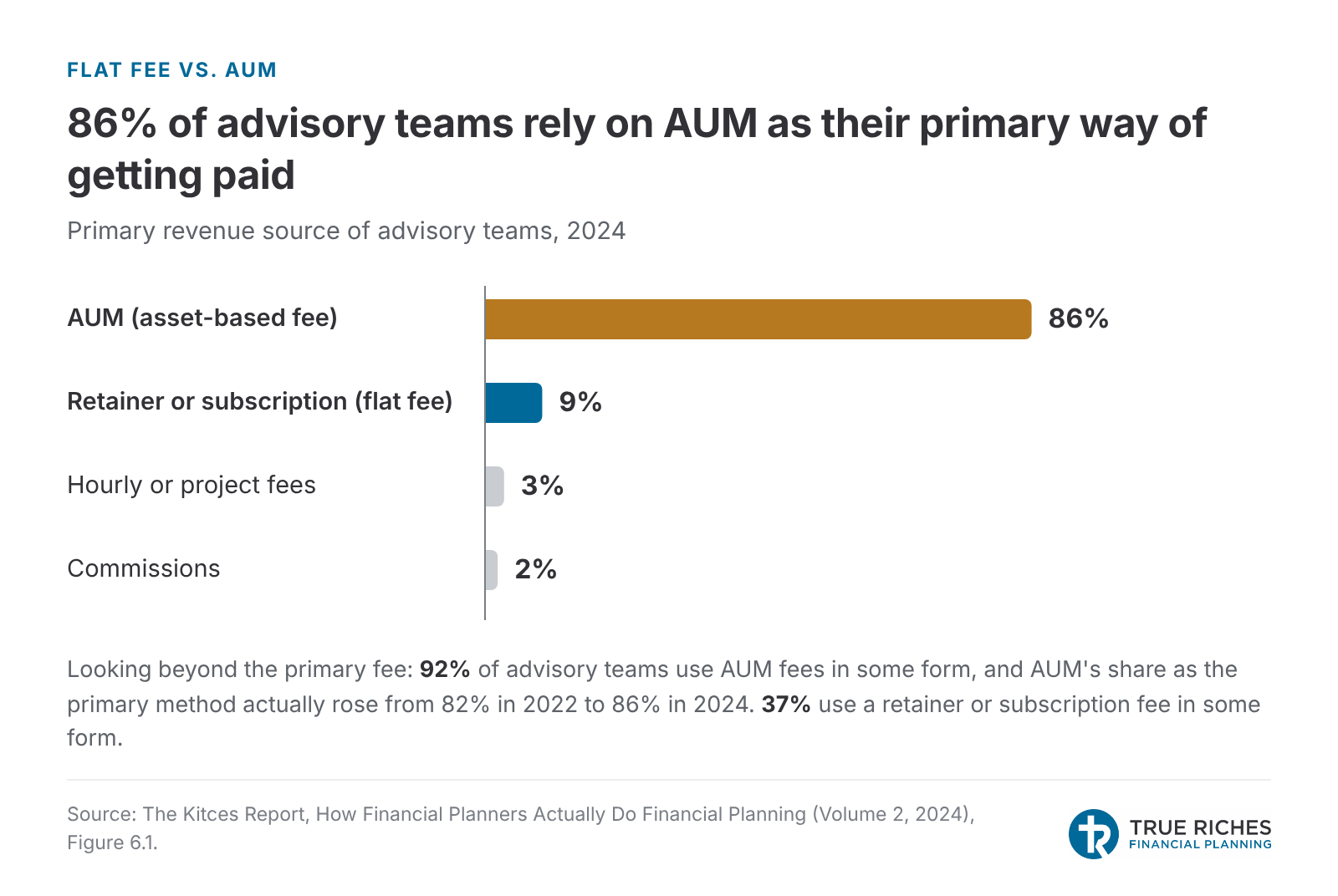
AUM has been the default for decades, simply because most consumers don't don't know a flat fee model exists.
The Heart Behind How We Price at True Riches
With my full hand laid on the table, I believe it's important to understand how an advisor charges, and why they charge the way they do. While I am very proud of our fully transparent flat fee calculator and the thought that has gone into it, it's mostly about conceptual values.
Profit is a good, biblical thing. I rather like the "profit is permission" motto I originally heard from Carl Richards. A business needs to earn a healthy enough profit to keep investing in a top-quality service offering, and without appropriate profit, the business (and the valuable service it provides) simply won't exist anymore. Profit is a biblical concept! 2 quick Proverbs [though there are more]: (1) "All hard work brings a profit, but mere talk leads only to poverty" (Proverbs 14:23, NIV). (2) "The plans of the diligent lead to profit as surely as haste leads to poverty." (Proverbs 21:5, NIV). Jesus Himself told several parables about the relationship between diligent work and profit [such as the Parable of the Talents]. I'm not shying away from running a healthy, profitable business, and you shouldn't want your advisor to be unprofitable either [an unprofitable advisor may not be around in 5-10 years].
But here's the flipside: Our call as Christians isn't to extract every last penny that we could from clients in the name of capitalism. At some point, I believe you have to rest in "enough" and intentionally leave some potential profit on the table in the name of doing what's best for your client (which, as fiduciaries, we're called to do in the first place!).
Industry leaders in financial planning have consistently talked about the fact that AUM advisors with higher-net-worth clients (such as $2M+) make more on average than flat-fee advisors, with a smaller number of high-net-worth clients making close to 80% of the revenue and skewing the revenue-per-client upwards by subsidizing lower-net-worth AUM clients.
When Your Social Media Feed Had "an End": Meta and Unbridled Capitalism
Do you remember the early days of Instagram and social media, when your feed actually had an end? You'd scroll, see what your friends were up to, then hit the post from Susie you had already seen the other day and realize that was it! Man I miss that social media experience (though it wasn't perfect of course). But it wasn't built to monetize every second of your attention I'll say that.
Fast forward to today. In my opinion, Meta (the parent company of Facebook and Instagram) is a textbook example of unbridled capitalism: an endless, algorithm-driven feed designed to keep you scrolling, with nearly every second of your attention turned into ad revenue. And sometimes that's come at the expense of vulnerable populations such as children (the latest settlement from August anybody?)
I share this not to pile on one company, but because it's such a clear picture of what happens when the goal of a business becomes extracting as much as possible from people, rather than simply serving them well. It's also a big reason I'm passionate about Biblically Responsible Investing (BRI), and why we offer faith-based investing at True Riches. BRI asks a simple question about the companies we own: is this business (i.e. WORK we are promoting) creating honest, tangible value for its customers, employees, and communities, or is it extracting value from them? "When the righteous prosper, the city rejoices" (Proverbs 11:10, NIV). I want the companies we invest in to be the kind that make the city [and God] rejoice, because that was the design of Work all along.
And honestly, it's the same question I try to ask about my own business. I don't want True Riches to monetize every possible dollar of a client relationship just because it can.
Gleaning, the Golden Rule, and Work for the Common Good
The Old Testament has a beautiful principle for the concept of "enough" called gleaning:
"When you reap the harvest of your land, do not reap to the very edges of your field or gather the gleanings of your harvest. Do not go over your vineyard a second time or pick up the grapes that have fallen. Leave them for the poor and the foreigner. I am the LORD your God." (Leviticus 19:9-10, NIV)
The farmers in Israel were allowed (and expected!) to profit from their harvest. But they weren't supposed to squeeze every last grape out of the field -- they left the edges. To me, a flat fee that doesn't automatically rise with every dollar your portfolio grows is one practical way of leaving the edges of the field. I've written about the concept of "enough" in our personal lives in Establishing Personal Wealth and Spending "Finish Lines", and I believe the same principle applies to running a business.
The golden rule. "So in everything, do to others what you would have them do to you, for this sums up the Law and the Prophets." (Matthew 7:12, NIV). If I were the client, I'd want an incredibly valuable service at a fair price, from someone whose advice wasn't subjected to conflicts by how they get paid and how much they got paid. Shouldn't I be the type of person who offers that to others? I strongly believe so.
Work is meant to serve the common good. I believe the goal of business (aka work) is to serve others and promote human flourishing. If we're all extracting as much as possible from everyone and everywhere we go, what type of world are we contributing towards? I'd much rather build a business that's healthy, profitable, AND generous toward the people it serves.
How We Price at True Riches
At True Riches, we quote a custom flat fee based on YOUR specific situation, including:
- Complexity: things like equity compensation, self-employment income, investment real estate, multi-state income, existing annuities or permanent life insurance, advanced estate planning needs, inherited retirement accounts, or concentrated stock positions
- The breadth and depth of planning: our ongoing service covers biblically-grounded financial planning, faith-driven investment management, AND personal tax return preparation
- The size of your managed portfolio, which moves the fee rather incrementally as opposed to a linear 1:1 relationship like traditional AUM
You can get a quote on what your fee would be using the fee estimator on our pricing page. It asks about those complexity factors plus the approximate size of your portfolio.
Here's the important part: once your flat fee is set, it does NOT change with your portfolio's value. It simply increases by a fixed 3% each year, and that's it. If the market has a great year, or you save another $80,000, or you rollover an old 401(k), your fee doesn't change. We also cap the number of client households we serve at 40, which is another practical expression of "enough" for us. We'd rather serve fewer families really well than grow at all costs.
Conflicts of Interest Under Each Model
Under AUM, your advisor gets paid more when your portfolio is bigger and less when it's smaller. Most of the time that feels aligned ("we both want the portfolio to grow!"). But a LOT of the most important financial decisions you'll ever make involve moving money out of the portfolio, and that's where the conflict shows up.
If you knew your advisor's recommendation could be tainted by how much they get paid, would you trust it the same way? Here are some real examples:
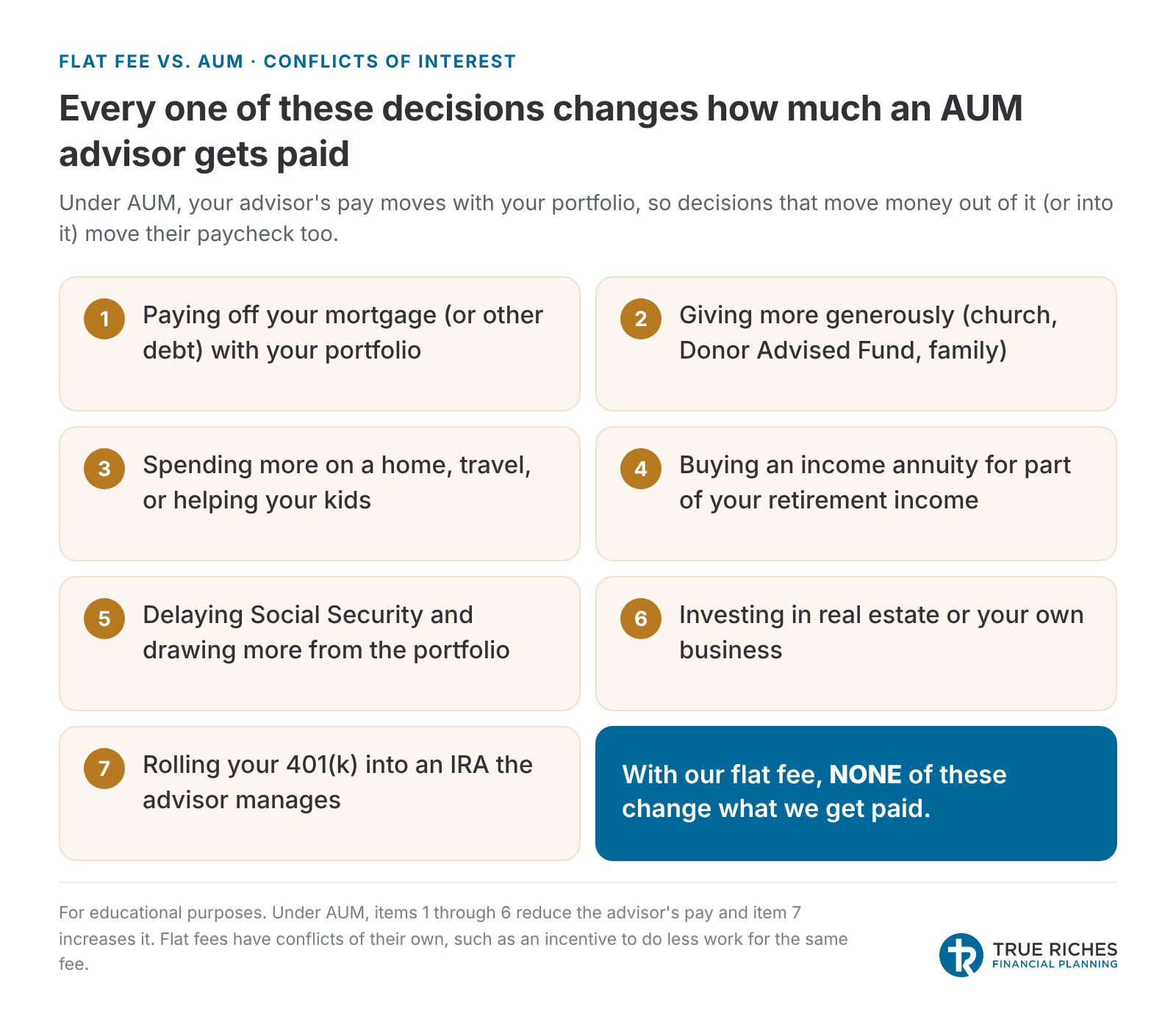
With our flat fee, none of these change what we get paid. That gives our clients more confidence in our ability to give objective, unbiased advice over time.
To be clear, I'm not saying AUM advisors give bad advice [most advisors I know are good people who genuinely care about their clients], but if one got to choose...wouldn't you choose having less embedded conflicts of interest?
To be clear, flat fees aren't conflict-free either. In fairness, a flat fee creates an incentive to do less: if the fee is the same no matter how much work goes into your situation, a flat-fee advisor could be tempted to cut corners. Capping True Riches at 40 client households is just one of the many ways we protect against this.
Conclusion
While a flat fee is not perfect, I believe it has far fewer conflicts of interest than AUM for the segment of clients we serve.
If you're a strong accumulator earning $250k+ or have a $1M+ nest egg and you're paying an AUM fee today, here's one simple thing to do: add up what you actually paid your advisor last year in dollars, not the percentage. For a lot of people, seeing that number is eye-opening.
At True Riches, we specialize in serving physicians, employees with equity compensation, sales professionals, parents, and pre-retirees and retirees. If that's you and you'd like to see what a flat fee would look like for your situation, I'd love to chat. You can book a complimentary Discovery Meeting here. No commissions, products, or awkward sales pitches here!
Frequently Asked Questions
Is "flat fee" the same thing as "fee-only"?
No, and this one trips a lot of people up. "Fee-only" describes WHO pays the advisor (only you, no commissions). "Flat fee" describes HOW that fee is calculated. A fee-only advisor might charge AUM, a flat fee, hourly, or some mix. True Riches is both fee-only and flat-fee.
Are AUM advisors bad?
Not at all. Many excellent fiduciary advisors charge AUM, and it can be a great fit for some people. My point is that the pricing model itself creates certain conflicts, and for the people we serve, a flat fee is often the more aligned choice.
If my fee doesn't grow with my portfolio, won't my advisor care less about my investments?
Fair question! As a fiduciary, I'm legally and ethically required to act in your best interest either way. And practically speaking, a client whose plan and investments are working for them is a client who stays for the long haul, which is where the true incentive as an Advisor is.
Does a flat fee ever go up?
Yes, by a fixed 3% per year to keep up with rising costs so we can keep appropriate profit margins for a sustainable practice to be here for the long-haul.
What's included in the True Riches flat fee?
Our ongoing service includes holistic, biblically-grounded financial planning and advice, done-for-you income and expense tracking, proactive tax planning and Form 1040 tax return filing, faith-driven investment management, charitable giving strategies, employer benefits optimization, equity compensation strategy, retirement planning and "what if" modeling, a digital estate plan, and kids' education funding options. You can see the full list on our pricing page. But at its core, financial planning in the process in which we get you from where you are now to where you want to go. We start with where you are now, your life vision, and create a roadmap to bridge the gap between the two.
Disclosures
DISCLAIMER: These posts are intended to serve solely as general financial education and not personalized tax, legal, or investment advice. Before considering acting on anything you see in these posts, first consult with your tax, legal or investment advisor.
References to specific companies (such as Meta) are for illustration only and are not a recommendation to buy or sell any security. Biblically Responsible Investing screens may cause a portfolio to perform differently than portfolios that don't use them.
Industry fee data is from The Kitces Report: How Financial Planners Actually Do Financial Planning (Volume 2, 2024).
True Riches Financial Planning is a fee-only registered investment adviser. Registration does not imply a certain level of skill or training. More information about our services and fees is available in our Form ADV Part 2A.
More from True Riches
Continue building your financial foundation


Christian Financial Planning to Invest, Give, and Live Abundantly.
Reach out for a complimentary "good fit" consultation.
