
Talking to Your Kids About Money as a Christian — Using the Live | Give | Owe | Grow Framework

Some of the parents I work with ask a version of the same question:
“How do I actually teach my kids to handle money well, beyond just telling them to save?”
And while I’m quickly learning that lectures are not the most effective method, I do think using the framework below that introduces the four uses of money [and their proper order] is a great tool to use with kids (whether minors or adults) and gets them thinking about the conundrum we all find ourselves in – prioritizing and balancing where finite resources/money goes between different buckets, each of which serves a different purpose.
There are 4 things you can do with money after it’s earned
Once you have money, you can do 4 things with it:
- Spend on Yourself (“Live”)
- Give to Others (“Give”)
- Pay Taxes (“Owe”)
- Invest for Future (“Grow”)
In today’s post, I’m going to introduce what I believe to be a prudent, yet life-giving allocation across the 4 uses of money that can be reasonably applied to the majority of Christian households, whether it’s a 16-year old who has a summer lifeguarding job or a 23-year old with their first full-time adult job out of college or a 40-year old middle class family. This is my “Dave Ramsey Baby Steps” for how to proportion out your cash-flow. With that said, it is not intended to be legalistic or one-size-fits-all whatsoever. There is a major difference between general financial education (what this is) and personalized financial advice.
Before sharing in-depth about the 4 buckets, I do want to call out an important and often-neglected concept. Stewardship doesn’t begin once money has hit our bank account – it also encompasses how we earn money in the first place. I’ve seen a diagram that looks like Figure 1 below, and while I don’t think it’s ‘wrong’, I do think it’s Incomplete. A more Complete diagram of Stewardship I believe looks like Figure 2.
Figure 1: Incomplete View of Stewardship

Figure 2: Complete View of Stewardship
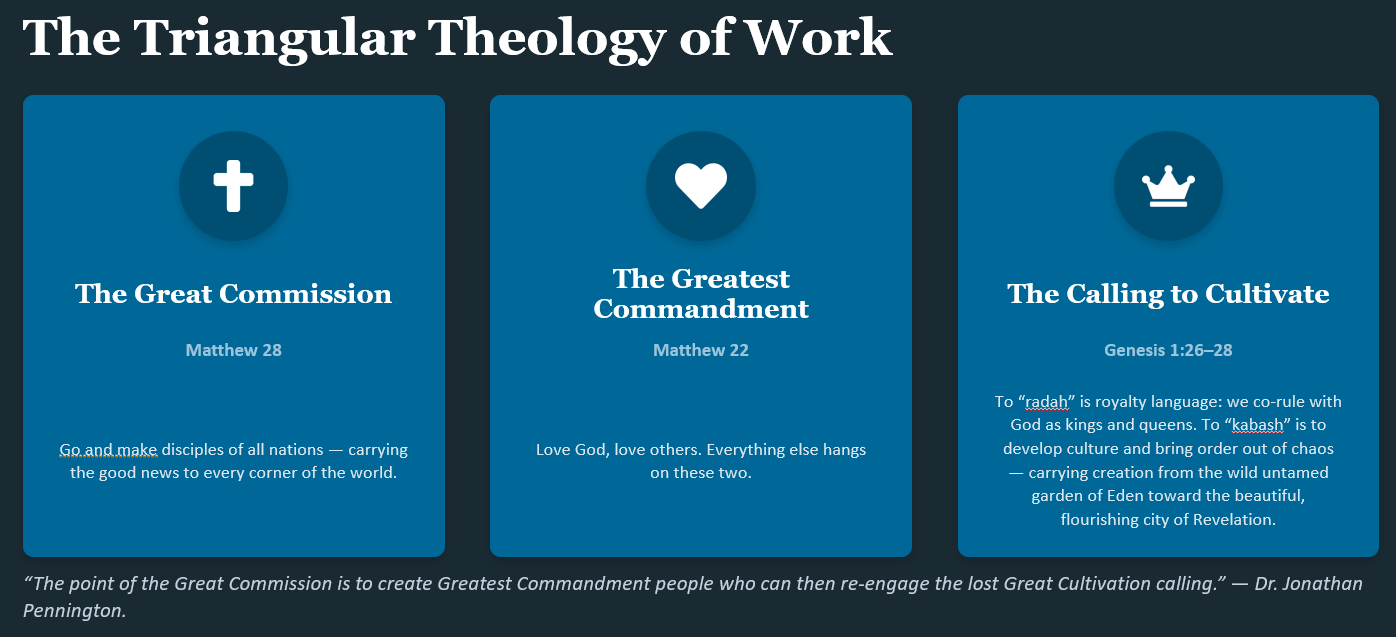
Work matters to God. Deeply. And while the point of this post isn’t to flesh out the entire “theology of work”, the basic premise is that God created us with meaningful work to do before the Fall. We were intended to “co-rule” with God in bringing the world forward to promote human flourishing – from the garden in Genesis to the city in Revelation. If you want to go deeper into the theology of work, you can check out the books Garden City by John Mark Comer or Every Good Endeavor by Tim Keller as a great starting point. But here’s a concise infographic in the meantime that I think sums up the theology of work nicely:
Using “dirty money” for good isn’t a biblical concept – it’s what the book of Proverbs calls “ill-gotten gain”. How we earn matters, and I think deep down all of us know this to be true, but sometimes realizing the commitment and potential sacrifices that come with earning a good and honest wage steer us towards the paths of shortcuts or questionable morality. Just remember that God would never call you into a profession [or HOW we operate within that profession] that doesn’t align with how He calls us to live in His word. Remember that “His divine power has given us everything we need for a godly life…” [2 Peter 1:3].
Okay, now onto the 4 uses of money once it’s been earned [the meat and potatoes of today’s post].
The Allocation Between the 4 Different Buckets
My recommended starting allocation across the 4 buckets is as follows, and in this order:
- Give 10% off the top of gross income (“Give”)
- Pay your legal share of taxes as a law-abiding citizen (“Owe”) – while this will differ based on how much income you earn and what type of income it is, a reasonable estimate for a young professional is 15% - 25%. For this post, we’ll use 15%.
- Invest 15% towards debt paydown or towards your future needs (“Grow”)
- Live off the remaining 60%, knowing everything else has been accounted for (“Live”)
How a Hypothetical $100,000 Gross Income Would Split

- GIVE | 10% | $10,000
- OWE | 15% | $15,000
- GROW | 15% | $15,000
- LIVE | 60% | $60,000
Owe shown at the low end of its 15-25% range
1. Give | 10%
While I don’t fall into the camp of thinking a Christian is required to tithe under the Old Testament Law, I do view the tithe as a floor rather than a ceiling. If you look at the New Testament, giving tends to be described as voluntary, cheerful, and sacrificial [2 Corinthians 9:7, 2 Corinthians 8:1-5]. And I can’t think of any New Testament examples where it’s below 10%, so I think 10% is a great starting point to build the muscle memory of giving.
There are entire books written on the subject of giving [both from a theological perspective and from psychological perspective], but here’s what I’d say about giving:
- Giving is the most joyful, impactful, and [dare I say] fun usage of money there is – humans were designed by God to experience tremendously deep, positive effects from helping others, and giving financially is one way to do that. Not to mention there is TREMENDOUS NEED in our world.
- Giving our FIRST 10% to recognize that all we have comes from God is a great principle to live by.
- Giving breaks the power of money over our hearts. The overarching picture the Bible paints is that God wants ALL OF OUR HEART more than anything else. Money is one of the most tempting “false idols” in our consumeristic culture today, and there’s no better way to slay the false idol than generosity towards others.
2. Owe | 15%
Owe is what goes to the government to fund government services as a citizen of the United States. It funds programs like Social Security, Medicare/Medicaid, National Defense, Education, Public Safety, Public-Transportation and Infrastructure like Roads and Parks. Use places kids go and know like their teachers, police officers or fire fighters, libraries, parks, etc. to explain some of what our tax dollars fund.
Of course, the actual tax % you owe depends on income, state, marital status, and more, but 15% is a good working assumption for kids (as Social Security/Medicare take up just over half of that, with the remainder going to Federal/State income taxes).
In Matthew 22:15-22, Jesus tells the Pharisees to give back to Caesar what is Caesar’s. Paul goes further in Romans 13:6-7 by tying paying taxes to honoring governing authority. I don’t think Christians have to agree with every dollar the government spends (I sure don’t, and I'm sure that goes for just about everybody), but I also don’t think Scripture leaves much room to treat taxes as optional. Minimizing them through legal strategy can be part of good stewardship, but simply refusing to pay what’s owed isn’t.
Here’s the other way I think about this bucket: your kid only ever owes tax because they earned income in the first place. Every dollar in Owe is downstream of provision – that doesn’t necessarily make paying taxes fun, but there is a lesson in gratitude here.
If you have a minor child who you are simply giving an allowance to [so they don’t owe any taxes], you could redirect the Owe category towards finding opportunities to give that % to the poor, underprivileged, or those who are just going through a really difficult season, as that is a core tenet of what the function of government was intended to do in the first place.
3. Grow | 15%
Grow is growing your net worth through either increasing your assets or decreasing your debts. Debt paydown is a pretty straightforward concept whereas investing is simply putting money aside for future needs like a new toy/gadget, a car, a down payment on a home, or retirement.
Explaining investing can be a bit tricky, so make it relatable to something they know. Investing is providing money to businesses that provide goods and services to other people [talk to them about a business they like and benefit from like a video game company, clothing store, favorite App they use, car they drive, etc.] – explain that in order to create that product/service, they needed up-front money to hire people with different skillsets to build what your kid sees today. Cars, video games, and clothes didn’t just magically appear overnight – they took money to fund research, development, and paying people who put their skills towards creating the product/service that your kid has come to enjoy. And in return for giving that business money, the business shares some of its profits with you, since you now own a part of that company with your invested dollars.
Remember – investing is ownership of work, with the prospect of participating in the upside financial returns of the work you are investing in. You can tie in biblically responsible investing by funding your dollars towards businesses you think are doing good work in the world, and that have reasonable potential to generate positive returns back to you as the investor over extended time periods.
We invest because we want to enable more good products and services that add value to other people’s lives, AND we need to grow our dollars faster than inflation. Inflation can be simply explained that a gallon of milk used to cost $1 and now it costs $4, or a pair of jeans used to cost $15 and now they cost $50. We have to grow our dollars faster than goods and services increase, or else we aren’t going to be able to afford our living needs in the future.
If you have an adult child, my most frequent suggestion is to forego retirement savings until they have an emergency fund in a High-Yield Savings Account that has 6-months of their Living Expenses saved. The only caveat to this is if your employer offers you a match with either no vesting schedule, or a vesting schedule you can reasonably foresee yourself working there long enough to capture in full. If your employer offers you a dollar-for-dollar 401k match up to 4% of your income and their employer match vests immediately, you can do 4% into the 401k and the residual 11% into a high-yield savings account. Once the 6-month emergency fund is fully funded, split it so that 10% of income goes into tax-advantaged accounts like a 401k, HSA, or Roth IRA – and the residual 5% of income goes into a Brokerage account.
A quick note on gambling and sports betting
There was a disturbing chart I stumbled upon recently that effectively showed over 50% of Gen Z has directed investing funds to sports betting in the last year with half of those treating sports betting as a deliberate part of a long-term financial strategy [chart below]. Sports betting, casino games, and the lottery are negative sum endeavors over time. Every dollar you win is a dollar that someone else lost, and the house takes their cut from that finite pool of available dollars, which is what makes it the negative sum game. Investing in something such as stocks (businesses, really) is a positive sum game, because businesses that innovate and create valuable products and services people need/want grow in economic dollar value over time. In other words, everybody can play the same game and all win [hence the positive sum game].
Outside of intermittent “entertainment expense”, I’ve always struggled with sports betting or negative sum games because the money earned isn’t adding value in of itself to society; every dollar you earn is simply taking money from somebody else – it’s not actually helping anybody through the process of earning the money. As mentioned earlier, I believe the Bible is clear that how you earn money deeply matters, and where your investment returns come from matter for the same reason. Proverbs 16:8-9 says: “Better a little with righteousness than much gain with injustice. 9 In their hearts humans plan their course, but the Lord establishes their steps.”. Proverbs 10:2 says: “Ill-gotten treasures have no lasting value, but righteousness delivers from death.”

4. Live | 60% [the remainder]
Live is everything else. For a working adult that’s housing, groceries, insurance, the car payment, gas, entertainment, travel, utilities, subscriptions, and everything else that comprises the entire cost of an ordinary life.
What I love about the Live category being last is that it allows for much more peace of mind and comfort IN spending money, because you know that everything else has already been accounted for – you are being generous towards others, setting aside your legal share for taxes, and investing for your future needs [and leaving MARGIN in your month-to-month cash flow]. You now have the joy and privilege of GETTING to enjoy spending money on life-giving products and services until you reach the remaining amount [60% of gross income in our example here].
Once you know your annual gross income, you can then start converting it into monthly dollars, and if you want to, even a weekly allotment from there. Here’s an example of how this framework would play out for a household with $100,000 of annual gross income:
- Give | 10% of gross | $10,000 per year | $833 per month
- Owe | 15% of gross | $15,000 per year | $1,250 per month
- Grow | 15% of gross | $15,000 per year | $1,250 per month
- Live | 60% of gross | $60,000 per year | $5,000 per month
By using this framework, you can build your “Lifestyle Budget” from the ground up until you reach the $5,000 per month, so that YOU tell your money where you want it go, rather than wondering where it all went. Remember that building a budget is to enable FREEDOM, as without one, you are much more likely to become a Slave to money, possessions, debt, and always wanting MORE.
Putting It All Together
None of this is a legal formula, and I don’t think it replaces a plan built around your kid’s actual numbers eventually (their income, state of residence, debt, and goals). But as a starting rule of thumb, I think it’s a genuinely good one, and one I’ve given a lot of thought to over the years. I like that it scales nicely from a summer lifeguarding job in high school all the way through a real career, and the percentages stay consistent for most of the journey.
A Few Practical Notes
—Everybody has a different ‘system’ that works for them when it comes to managing the 4 buckets. If we assume adequate taxes are being withheld by your child’s employer (so the Owe 15%), most payroll systems are setup today to allow for you to allocate your paycheck to multiple accounts. For example, you could have your paycheck go 3 different ways – 10% to a checking account earmarked for giving, 15% to a high-yield savings account, and the residual 60% to a checking account for spending [though technically it would be closer to 12% Give | 18% Grow | 71% Live assuming you are only working with 85% of gross income since the 15% Owe was already deducted]. You could also send all of it to 1 checking account and setup automated transfers to the giving and savings account too – there’s no gospel on right or wrong method.
If you are doing an allowance system for your minor child, consider having separate envelopes [if you are paying them cash], so that they can get in the habit of intentionally earmarking funds into these 4 different buckets to build good habits for adulthood.
—Model it yourself first. Kids pick up a lot more than we give them credit for, and probably the biggest influence on your kids’ financial habits as adults will come from observing you, their parents, handle money. Bring them into the conversation where appropriate – talk to them about your system, bring them into giving discussions, talk to them about where you’re investing your money, and to be thankful for God’s provision when you get the opportunity to experience life-giving memories together.
If this post was insightful or helpful to you, consider forwarding it to other parents you know or directly to your kids if they are old enough for it!
More from True Riches
Continue building your financial foundation



Christian Financial Planning to Invest, Give, and Live Abundantly.
Reach out for a complimentary "good fit" consultation.
