No Matter What You Do With Your Money, There's a Risk Involved
"The stock market is too risky for me. I like to keep my money safe in cash, CD's, or guaranteed-annuities."
I hear some version of this all the time, and quite honestly, I understand where it comes from. If you lived through 2008 or watched your 401(k) drop in 2022, keeping your money somewhere it can't go down often feels like the prudent thing to do. A lot of us were raised to think about money this way too [maybe you had a grandparent who kept everything in CDs and was proud to never have "lost" a dollar].
But there's an idea I don't hear talked about nearly enough, even within my own industry: no matter what you do with your money, there is a risk involved.
Keeping money in cash doesn't remove risk. It trades one risk for a different one. And the question isn't "Is the stock market risky?" [it can be with an improper time horizon]. The question is: "Which risk is the biggest threat to my goals, and are my investments best positioned to protect me from those risks?"
The Types of "Risk" Explained
When most people call an investment "risky," they typically mean the price can change dramatically and quickly. That's real, but it's only one of four risks [there are more out there] that we'll explore today:
- Volatility Risk: the price goes up and down, sometimes sharply. Since 1928, the S&P 500 has had a negative year 26 times out of 98, and has had peak-to-valley drawdowns of more than 40% before.
- Sequence of Returns Risk: bad returns show up at the worst possible time; right before or right after you start pulling money out to consistently live on. Retiring in years like 1964 and 1999 are prime examples of this risk at play.
- Inflation Risk: prices rise faster than your money grows. Inflation has averaged about 3% per year since 1928. At that rate, $10,00 sitting in a checking account for 25 years would only buy what about $4,780 buys today.
- Shortfall Risk: your investments don't grow enough to keep up with inflation and/or fund your goals (retirement, giving, or what you pass on to your kids / grandkids) in real, inflation-adjusted dollars.
Volatility is the main one people see, so understandably it's the main one that gets talked about. Shortfall risk is much quieter because your cash balance never goes down, it just buys less every year, and a lot of people don't realize the math isn't working until it's too late to adjust course.
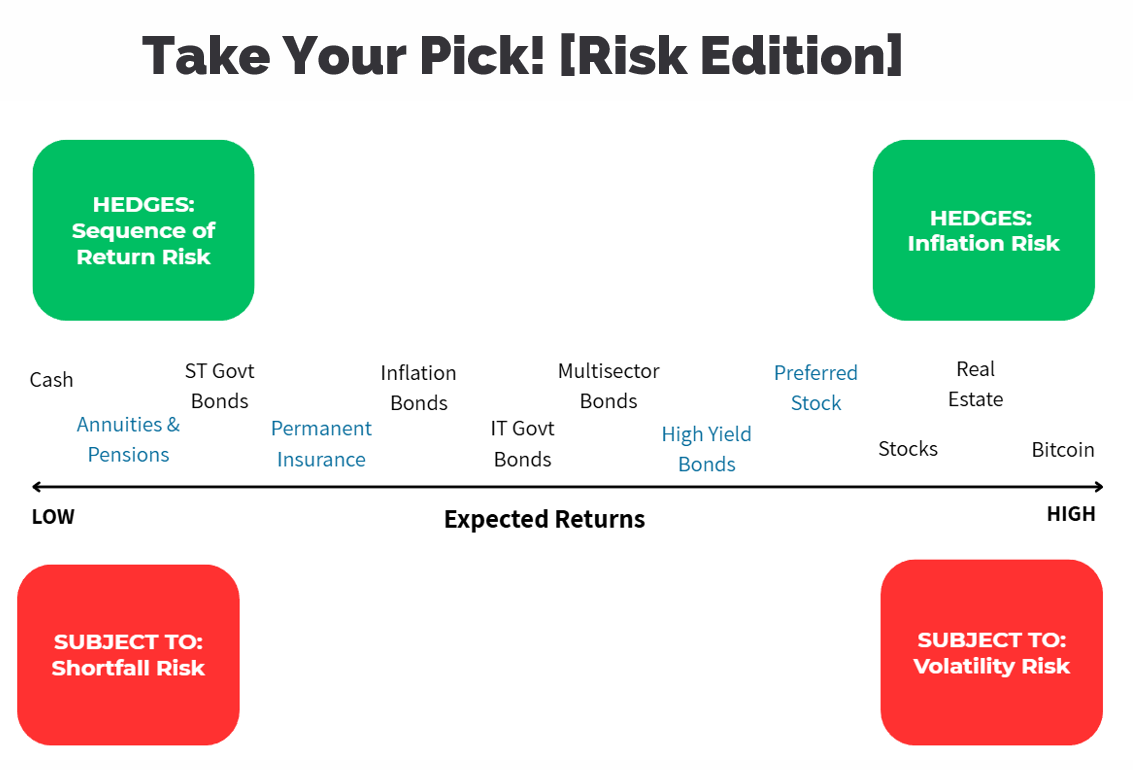
Every Investment Protects You From One Risk and Exposes You to Another
Along the bottom is expected return [for our purposes today, we'll assume that risk and return are linearly related], from low (cash, annuities and pensions, short-term government bonds) to high (real estate, stocks, Bitcoin). Now look at the top and bottom corners:
- The left side Investments hedge Sequence of Returns Risk. These investments are more stable, so you're never forced to sell something that just dropped 30% to pay your bills. But they're subject to Shortfall Risk, since their returns often barely keep up with inflation [and sometimes don't].
- The right side Investments hedge Inflation Risk. Over long periods, these have grown meaningfully faster than prices. But they're subject to Volatility Risk, so you need to be able to sit through some ugly years.
There's no spot on that line that hedges every risk and exposes you to none. Every option is a trade-off, including doing nothing.
What Does "Safe" Money Actually Cost?
Using some historical data from NYU and the Federal Reserve (1928 through 2025), here's the compound annual return for each, before and after inflation:
- 3-Month T-Bills (a stand-in for cash) | 3.4% per year | 0.3% after inflation
- 10-Year U.S. Treasury Bonds | 4.5% per year | 1.4% after inflation
- S&P 500 (with dividends reinvested) | 10.0% per year | 6.9% after inflation
Since 1928, there have been just shy of 80 rolling 20-year periods, and the S&P 500 beat T-bills after inflation in every one of them to-date. The worst 20-year stretch for stocks still managed to barely beat inflation over that time period, whereas the worst 20-year stretch for T-bills lost about 3% per year to inflation. Past performance is no guarantee of future results, but I think looking at past data helps us reframe the conversation away from blanketly saying "stocks are risky, cash is safe".
Why Sequence of Returns Risk Still Matters
If that makes it sound like everyone should own 100% stocks, hold on. Say someone retired at the start of 2000 with $1,000,000 in the S&P 500. They withdraw $50,000 the first year [5% withdrawal rate] and increase it each year for inflation. Using the actual returns since 2000, they would have completely run out of money in about March of 2016 [only 16 years into retirement - OUCH!].
On the flip side, if someone owned all bonds (50% short term US treasuries | 50% US aggregate bonds), they would have become insolvent in June 2025.
But the portfolio that was 60% stocks and 40% bonds still had ~$211k remaining in June 2025.
So Which Investment Is Actually "Riskier"?
It depends on you! I often talk about how risk tolerance is a poor primary determinant of growth vs conservative investments [because it is based on emotions that are fleeting], and we need to build your financial plan and investments on more solid ground than emotions that come and go through the seasons. This is the true difference between an AI algorithm or general financial education vs personalized financial advice, as the latter starts by building a foundation of everything about you, your life, your goals, your predispositions, fears, hopes, dreams, etc. and THEN [and only then] can you start to build an appropriate investment allocation that best hedges the primary risk(s) you are facing. But here's 3 hypothetical scenarios to demonstrate the concept in general terms:
- Mark and Jenna, Age 38, have $500,000 in savings and CDs they won't touch for 25 years because they "don't trust the market." Their real risks are shortfall risk and inflation risk, and their "safe" choice is exposing them to exactly those.
- Dave and Linda, Age 55, retire next year with 95% in the S&P500 because "it's done great lately." Their biggest risk has shifted to sequence of return risk, and they need a Stability Portfolio in place to match their short-term withdrawals against before retirement starts.
- Bob and Carol, Age 74, have pensions and Social Security that cover all their spending. They also have $2 million invested, mostly in CDs, because they "should be conservative" at their age. But they won't spend this money. It's realistically going to their kids, grandkids, and the ministries they care about, so its time horizon is their heirs', not theirs. Their biggest risk is shortfall risk, meaning they pass on far less real dollars (i.e. inflation-adjusted dollars). Being retired doesn't automatically mean your money should be conservative.
(These are hypothetical cases for general illustration, not actual clients or advice)
How We Balance the Opposing Risks at Play
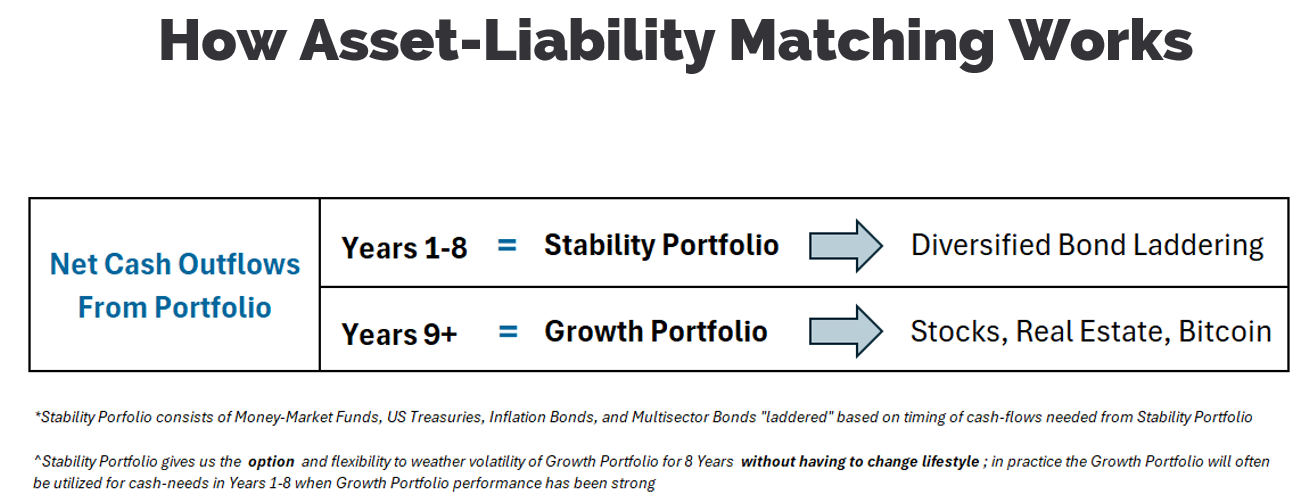
At True Riches, we use Asset-Liability Matching, which simply means matching each invested dollar to its job and when you'll need it:
- Stability Bucket: this covers your near-to-intermediate term cash withdrawals and sits on the left side of the above chart (cash, short-term Treasuries, TIPS, etc) to hedge sequence of returns risk. As a starting point, we typically target 8 years of net cash outflows from your portfolio. That's what you'll need to pull from your investments after Social Security, pensions, and other sources of gauranteed income. From there, we adjust the number of years up or down based on your individual circumstances, goals, and tendencies.
- Growth Bucket: everything else, invested on the right side of the above chart (broadly diversified, low-cost stock funds and real estate, most often) to hedge inflation and shortfall risk. It may be volatile in the short-term, and that's okay, because you've already prepared to not need the Growth Bucket money for at least 9 years given the Stability Bucket protects Years 1-8. It's a lot easier to "stick to the plan" when you can say to yourself "Geez if I don't think this economic downturn will persist for another 9 years, I guess I've already planned for this and can get back to my day now."
Putting It All Together
There's no risk-free choice with your money, and even leaving it all in savings carries heightened risk. So instead of asking "Is this investment risky?", try asking:
- What is this money for, and when will it be needed?
- Which risk is the biggest threat to that goal?
- Is my money positioned to hedge THAT risk, or only the one that feels scariest?
I think about the parable of the talents here. The servant who buried his master's money out of fear was rebuked, and his portion was given to the one who doubled their money. Faithful stewardship means understanding what the money is for and positioning it to actually accomplish that.
DISCLAIMER: This article is for general educational purposes only and is not personalized investment, tax, or legal advice. Historical returns are based on index data, which does not reflect fees, expenses, or taxes, and you cannot invest directly in an index. Past performance does not guarantee future results. All examples are hypothetical and for illustration only.
More from True Riches
Continue building your financial foundation


Christian Financial Planning to Invest, Give, and Live Abundantly.
Reach out for a complimentary "good fit" consultation.
