Our Investment Process · 8-minute read
How We Build Your Investment Portfolio (And Why)
One of the first things people want to know before hiring a financial advisor is, "How will my assets be invested?" It's a great question to ask, so we've outlined our process below, including why the order of the steps matters so much to successful investing.
Our portfolio construction process
Each step builds on the one before it, so the order matters.
Planning
01Your Life VisionGoals, dreams, values, calling, purpose02Full-Picture Financial Plan
Income, expenses, taxes, giving, assets, debts
Investing
03Asset AllocationThe mix of lending and owning, set by your cash flow04Asset Location
The right investments in the right types of accounts05Investing Style
Diversified, low-cost, tax-efficient
Step 1
Your Life Vision
Your portfolio needs a purpose before we can decide how to allocate it.
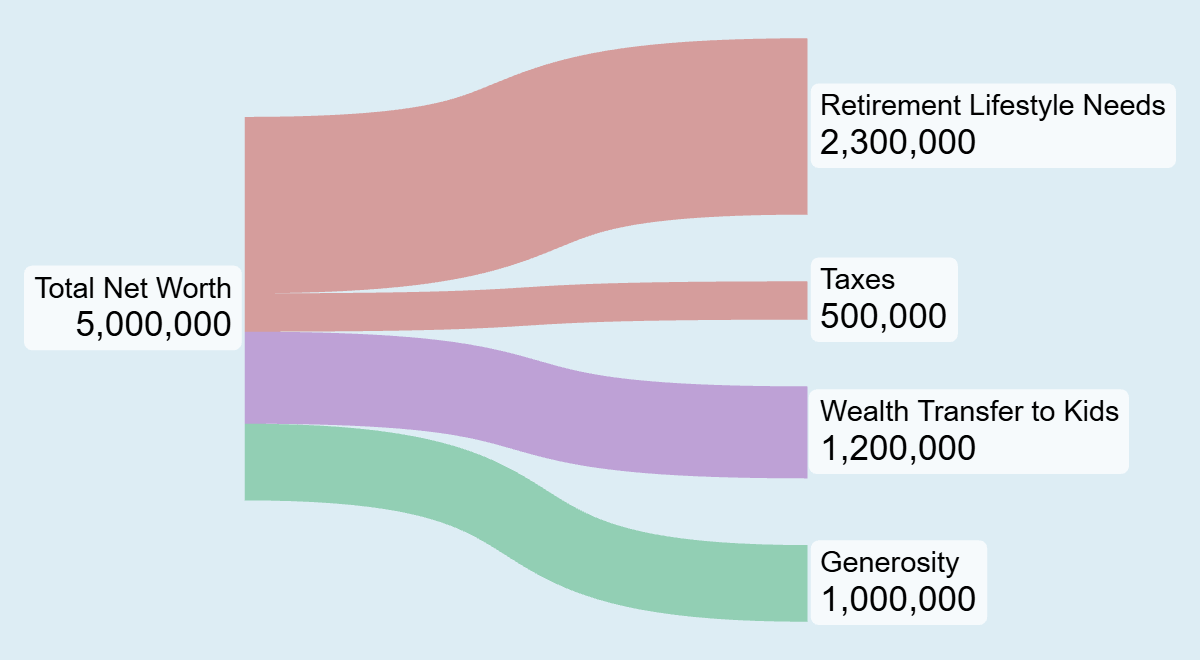
We start with a question most investors skip, which is "What is all of this money for anyways?" Your portfolio's job is to provide the cash you need, when you need it, to Live, Give, and Owe.
Your lifestyle, today and in retirement
Generosity and Kingdom impact
Taxes as a result of your provision
Through a collaborative process, we'll define how you want the money you've been entrusted to support the Life Vision and Calling the LORD has placed on your life. We do this by developing Statements of Financial Purpose and uncovering your Core Values.
Sample Statement of Financial Purpose
"Money is a tool that enables us to have flexibility over our time, bless our community generously, pursue our hobbies, and enjoy making life-giving memories with family & friends while feeling secure and confident in our long-term sustainability."
core values · Spouse 1
Adventure · Family · Freedom · Generosity
core values · Spouse 2
Service · Relationships · Faith · Security
Step 2
Full-Picture Financial Plan
We project how much money you'll need to support Your Life Vision, and when.
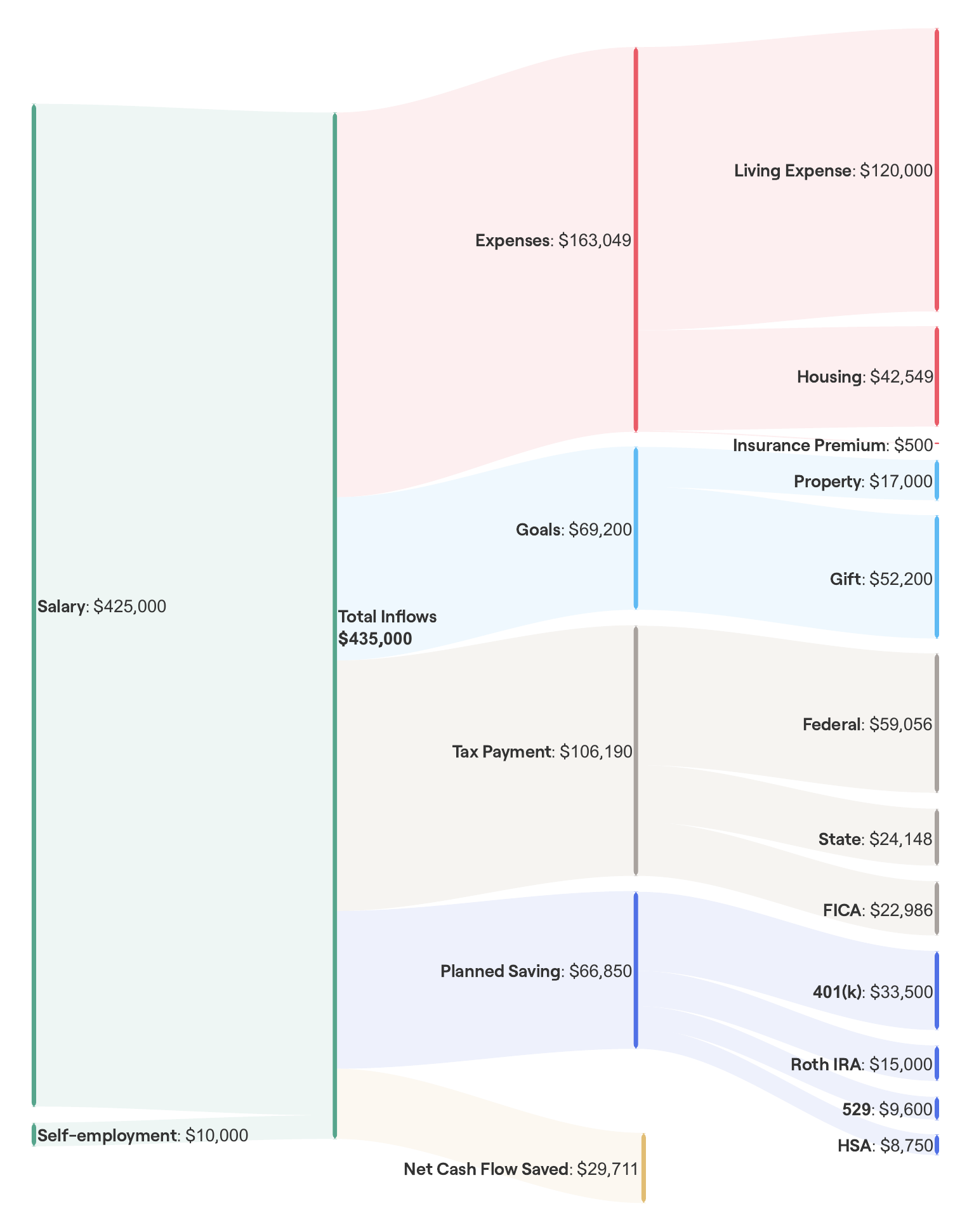
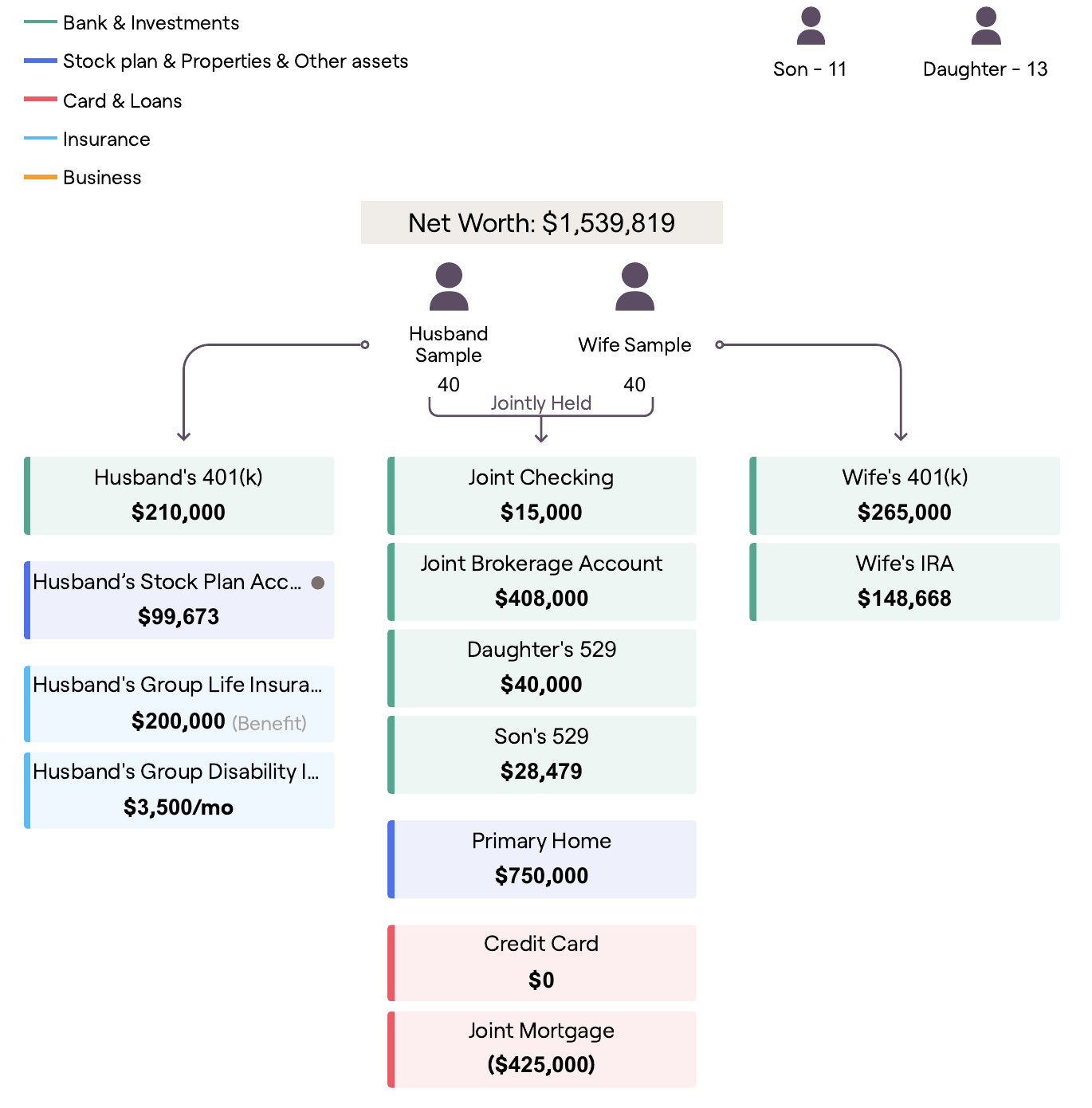
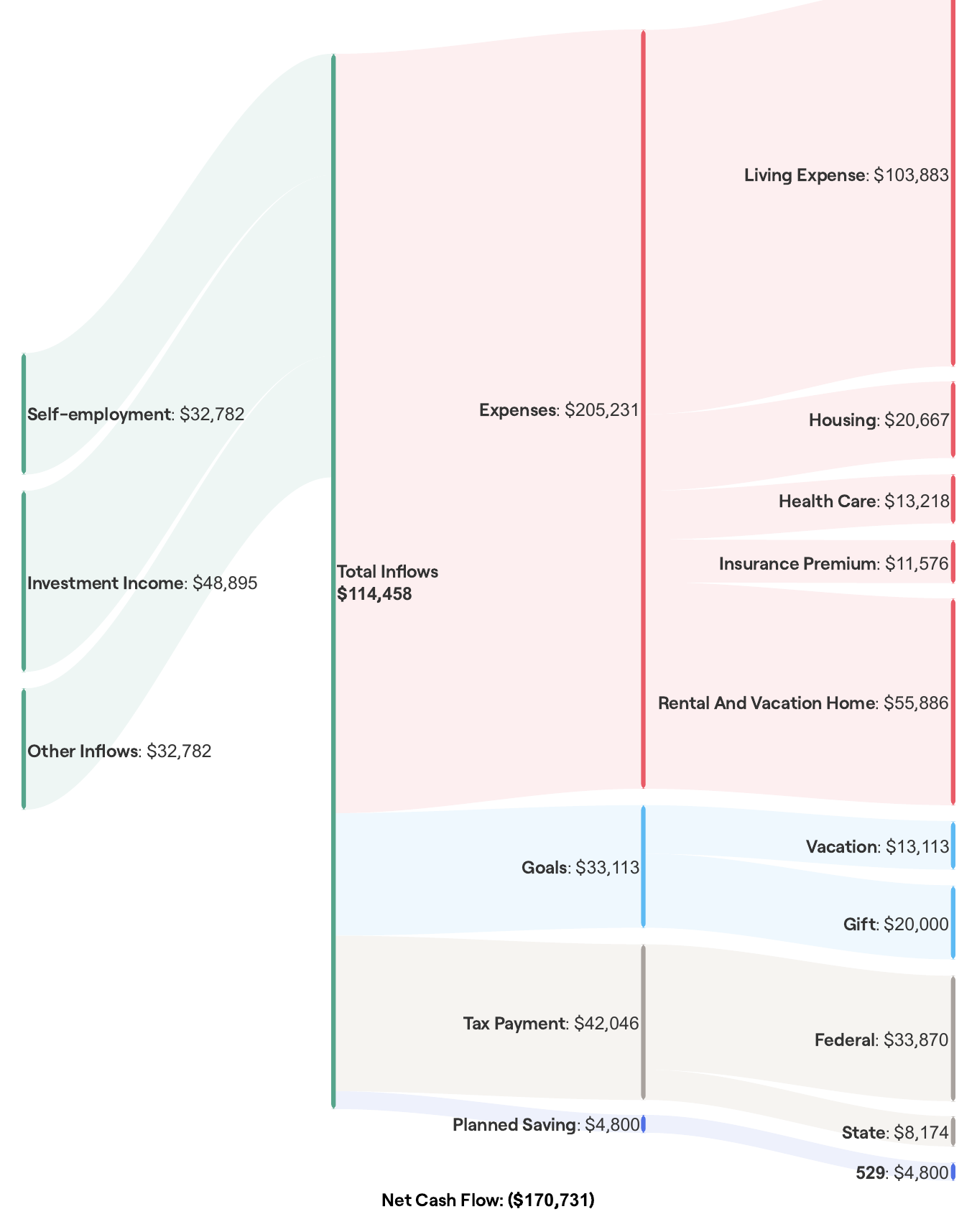
Next, we build a cash-flow-based plan in RightCapital [our financial planning software] that maps out, year by year, how much you'll need from your portfolio to Live, Give, and Owe after Social Security, pensions, and other income. That timeline drives Step 3.
Step 3
Asset Allocation
Every type of investment has a different, but specific job.
There Are Only Two Ways to Invest: Lend or Own
Every investment comes down to one of two things: lending your money, or owning something with it.
Lend [the Stability Bucket]
Bonds and cash
You loan money to a government, business, or bank, and they pay you interest. Prices move less, but returns have historically barely kept up with inflation over time.
Own [the Growth Bucket]
Stocks and real estate
You buy a piece of real businesses and property, and share in their profits and growth. Prices swing more in the short term, but historically, owning has built far more buying power over time.
Most of the world's wealthiest people built their wealth the same way: by owning businesses. So we want you to own businesses too [companies that create products and services people value, and grow in value over time as a result].
A lot of people tell me the stock market feels scary, so they'd rather keep their money in cash or CDs. I understand why. But a stock is simply a small piece of a real business. Its price can swing with the headlines in the short term, but over long periods business ownership has rewarded those who have a thoughtful and disciplined approach.
Every Investment Has a Tradeoff: The Key Is a Grounded, Time-Tested Approach to the Mix
Lending and owning each protect you from one risk and expose you to another. We believe what matters most is a data-driven, behaviorally friendly approach to optimizing the mix — and one that holds up no matter what's going on in your life or the markets.
Cash
Protects you from
Big swings in value. Cash doesn't drop when the stock market does.
Exposes you to
Inflation and shortfall risk. 3-month T-bills earned just 0.3% per year after inflation from 1928 to 2025.
Annuities & pensions
Protects you from
Running out of income for as long as you live, and swings in the market.
Exposes you to
Inflation [many payments aren't adjusted for it], shortfall risk, and less flexibility to change course later.
Short-term U.S. Treasuries
Protects you from
Market swings and sequence-of-returns risk [a bad market right when you need cash].
Exposes you to
Inflation and shortfall risk, since returns have historically barely beaten inflation over time.
Intermediate-term U.S. Treasuries
Protects you from
Much of the stock market's volatility. Often a safe haven for investors during periods of economic uncertainty.
Exposes you to
Interest-rate risk [prices can fall when rates rise, like in 2022] and inflation.
Inflation bonds
Protects you from
Inflation, over the life of the bond, since the value adjusts with prices.
Exposes you to
Shortfall risk [low returns after inflation] and some price swings when interest rates move.
Global bonds
Protects you from
Leaning on any one country's bond market, while earning a bit more income.
Exposes you to
Interest-rate risk and some credit risk [the chance a borrower doesn't pay you back].
Stocks
Protects you from
Inflation and shortfall risk over long periods. The S&P 500 earned 6.8% per year after inflation from 1928 to 2025.
Exposes you to
Volatility [drops of 40%+ have happened] and sequence-of-returns risk if you have to sell in a downturn.
Real estate
Protects you from
Inflation over long periods, since rents and property values have tended to rise with prices.
Exposes you to
Volatility. Publicly traded real estate can swing as much as stocks [sometimes more].
The Cost of Too Much Certainty [Lending vs. Owning]
| Investment (1928–2025) | Per year | Per year, after inflation | Difference vs. cash, after inflation | Worst single year [before inflation] |
|---|---|---|---|---|
| Inflation [Consumer Price Index] | 3.0% | — | — | — |
| 3-Month T-Bills [a stand-in for cash] | 3.4% | 0.3% | — | +0.03% [2014] |
| 10-Year U.S. Treasuries | 4.5% | 1.5% | +1.2% a year | −17.8% [2022] |
| S&P 500 [dividends reinvested] | 10.0% | 6.8% | +6.5% a year | −43.8% [1931] |
Compound annual returns, 1928–2025. Source: Aswath Damodaran, NYU Stern. After-inflation returns divide out inflation instead of subtracting it [for the S&P 500, 1.100 ÷ 1.030 = 1.068, or 6.8%], so they don't subtract evenly. Figures are rounded. The S&P 500 beat T-bills after inflation over all 79 rolling 20-year periods, but lost money in about 1 of every 4 calendar years. Indexes can't be invested in directly and don't include fees, expenses, or taxes. Past performance is no guarantee of future results.
The catch is that owning often comes with short-term price swings during times of economic uncertainty [like the dot-com bust in 2000, the 2008 financial crisis, Covid in 2020, and aggressive interest rate hikes in 2022]. So owning needs a longer time horizon for its higher expected returns to become more predictable, and lending [bonds] is what provides stability in the meantime.
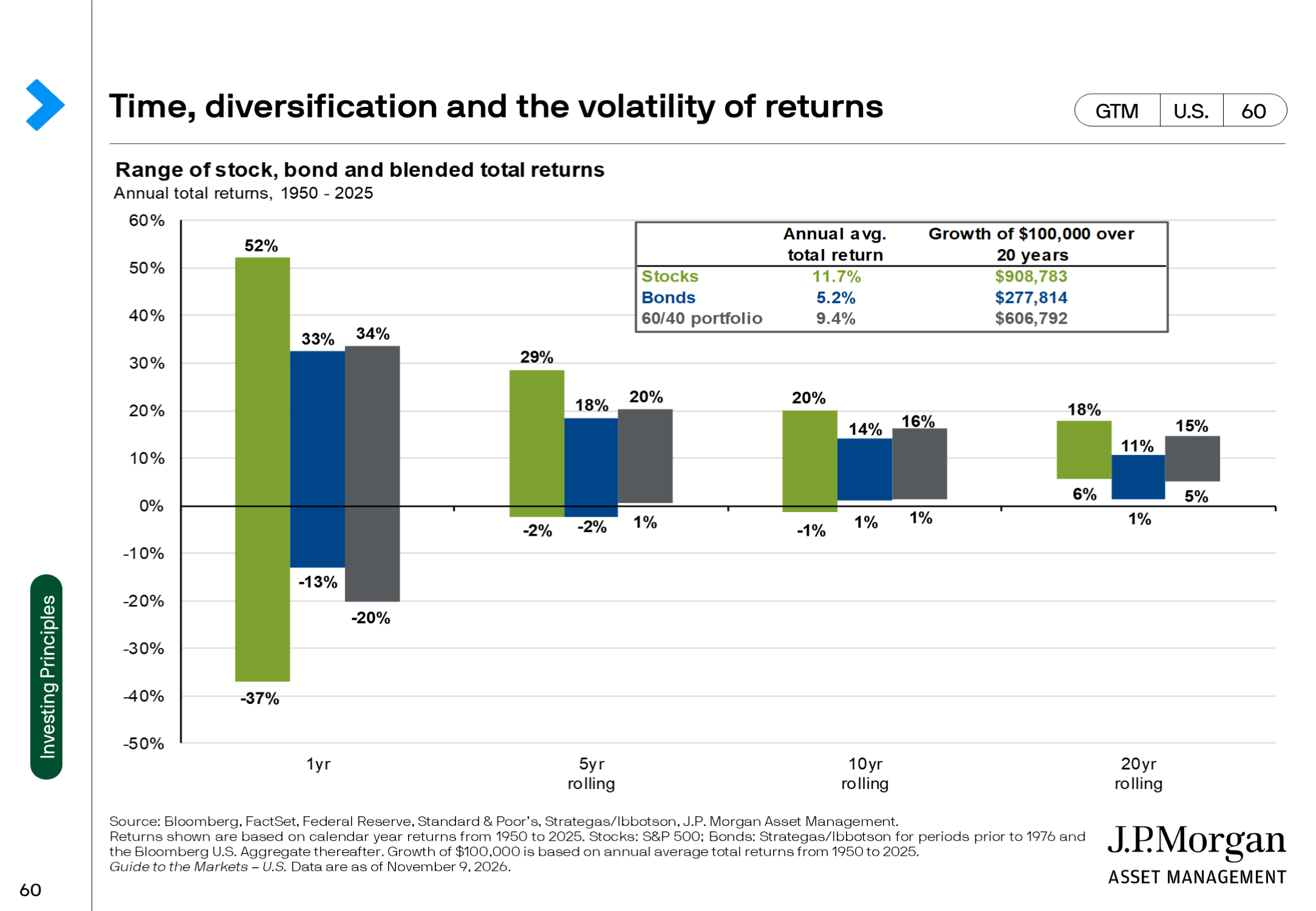
But how then do we decide how much goes toward lending vs. owning?
What We Don't Do
Most firms turn a risk-tolerance questionnaire [like the illustrated sample question] into a stock/bond mix. The problem is that feelings come and go. Behavioral finance research shows that our comfort with risk swings with recent events and common biases [like recency bias and loss aversion], which is why so many people love risk after a 20% up year and want out after a 20% drop. We believe your portfolio should rest on something more grounded than fleeting emotions.
A typical risk-tolerance question
In general, how would your best friend describe you as a risk taker?
What We Do Instead: Asset-Liability Matching
We match the timing of your assets [investments] to the timing of your liabilities [cash needs]. Money you'll need in the next few years shouldn't be invested like money you won't touch for decades. We do this with two buckets: a Stability Bucket, where you lend, and a Growth Bucket, where you own.
Ideally, you'd own as much of the Growth Bucket [stocks and real estate] as you can, since it's likely to build the most purchasing power [inflation-adjusted money] over time. But having to drastically cut spending or selling a depreciated investment to live off [sequence-of-returns risk] aren't winning strategies, and that's where the Stability Bucket [high-quality bonds and cash] plays an integral role.
Illustrative timeline of yearly withdrawals for a retiree
Withdrawals tend to be highest early in retirement [before Social Security starts and while travel is highest], then come down as spending naturally slows.
High-quality bonds and cash, laddered so each year's withdrawals are set aside ahead of time. Its job is reliability, not chasing returns.
Protects against: sequence-of-returns risk
Broadly diversified stocks and real estate. With 9+ years before it's needed, it has time to weather short-term volatility and work to outpace inflation.
Protects against: inflation and shortfall risk
About 8 years is our starting point for households drawing from their portfolio, adjusted to each plan. It's not a guarantee that markets will recover within that time.
Year 1 · Money markets / T-bills
Next year's withdrawals sit in cash-like investments, so your paycheck is ready no matter what the market is doing.
Years 2–3 · 1–3 year U.S. Treasuries
Short-term U.S. Treasuries that come due right around when the money is needed, with very little interest-rate or credit risk.
Years 4–5 · Inflation bonds [TIPS]
Treasury Inflation-Protected Securities adjust with inflation, which helps protect the buying power of money you'll spend a few years from now.
Years 6–7 · 5–7 year U.S. Treasuries
Intermediate-term U.S. Treasuries, which typically pay a bit more interest for money that's further out.
Year 8 · Global bonds
A broadly diversified mix of bonds for the last rung of the ladder, right before the Growth Bucket takes over.
Years 9+ · Growth Bucket: tocks & eal estate
Everything else is invested for growth. Since this money has 9+ years before it's needed, it has time to recover from downturns and work to outpace inflation.
Examples
Same Process, Two Very Different Portfolios
Your household's specific cash flows and time horizon set the mix, not a questionnaire or general rules of thumb.
Still saving, early 40s
A $1,100,000 portfolio for a family spending about $15,000 a month [$180,000 a year], with a new car 3 years from now that will require $40,000 from their portfolio. Since they're still saving, the Stability Bucket only needs to hold their emergency fund and that one known expense.
$970,000
Stability 12% · $130,000
Inside their Stability Bucket
Emergency fund [6 months × $15,000]$90,000
New car in year 3 [$40,000 from the portfolio]$40,000
Retiring couple, early 60s
A $3,400,000 portfolio that needs to fund about $1,230,000 of net withdrawals over the first 8 years.
$1,230,000
$2,170,000
Inside their Stability Bucket
Hypothetical examples for illustration only, not actual clients. Net withdrawals are spending plus taxes, minus Social Security, pensions, and other income.
Step 4
Asset Location
What you own matters. Where you own it matters, too.
Interest from bonds and cash is taxed at ordinary income rates every year, while stocks held in a brokerage account generally get better tax treatment [qualified dividends and long-term capital gains].
So when it makes sense, we hold more of the Stability Bucket in IRAs and 401(k)s, and more of the Growth Bucket in brokerage and Roth accounts.
$4,375 of interest a year, taxed at 40.2% = $1,759 of tax.
Flip to "After" to see the same investments held in different accounts.
$2,188 of qualified dividends a year, taxed at 23.2% = $508 of tax.
About $1,251 less tax every year, with the exact same overall investments.
Hypothetical example using combined federal and state tax rates for the "still saving" family above. Your rates and results will differ.
Step 5
Investing Style
We choose each investment for the specific role it plays.
This is the part most people think of as "investing." And while an important part of portfolio construction, it's imperative not to put the cart in front of the horse. Steps 1 through 4 are necessary to do Step 5 well. We tend to buy investments that are:
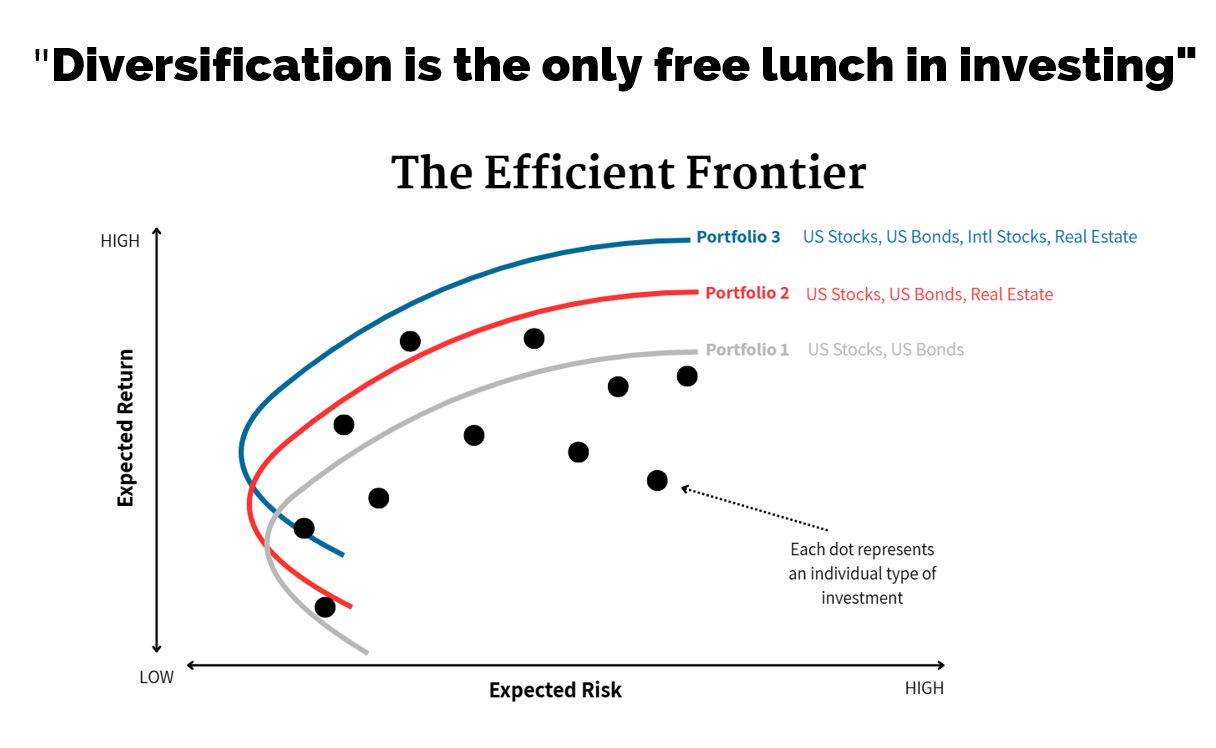
Broadly Diversified
Bonds of different types and maturities in the Stability Bucket. Thousands of businesses of different sizes, countries, and sectors, plus real estate, in the Growth Bucket.
Low-Cost
Fund fees are money that isn't compounding for you, so we mostly lean on low-cost mutual funds and ETFs [with two exceptions, explained below].
Tax-Efficient
We favor funds that rarely pay out capital gains, and we plan which accounts your withdrawals come from to keep your lifetime tax bill low.
Low-cost exception 1
Biblically-Based Investing
For those who are convicted to align their investments with their core values. While cost is still a consideration, it's not the sole driving factor in fund selection.
Low-cost exception 2
Global Bonds
Our global bond segment is an active strategy with high turnover. It targets a niche segment of the global bond market with a very specific purpose, which no index exists to accomplish.
What's in the Growth Bucket
What we leave out
In Retirement
How Your Portfolio Becomes a Paycheck
A dependable paycheck, without chasing "income".
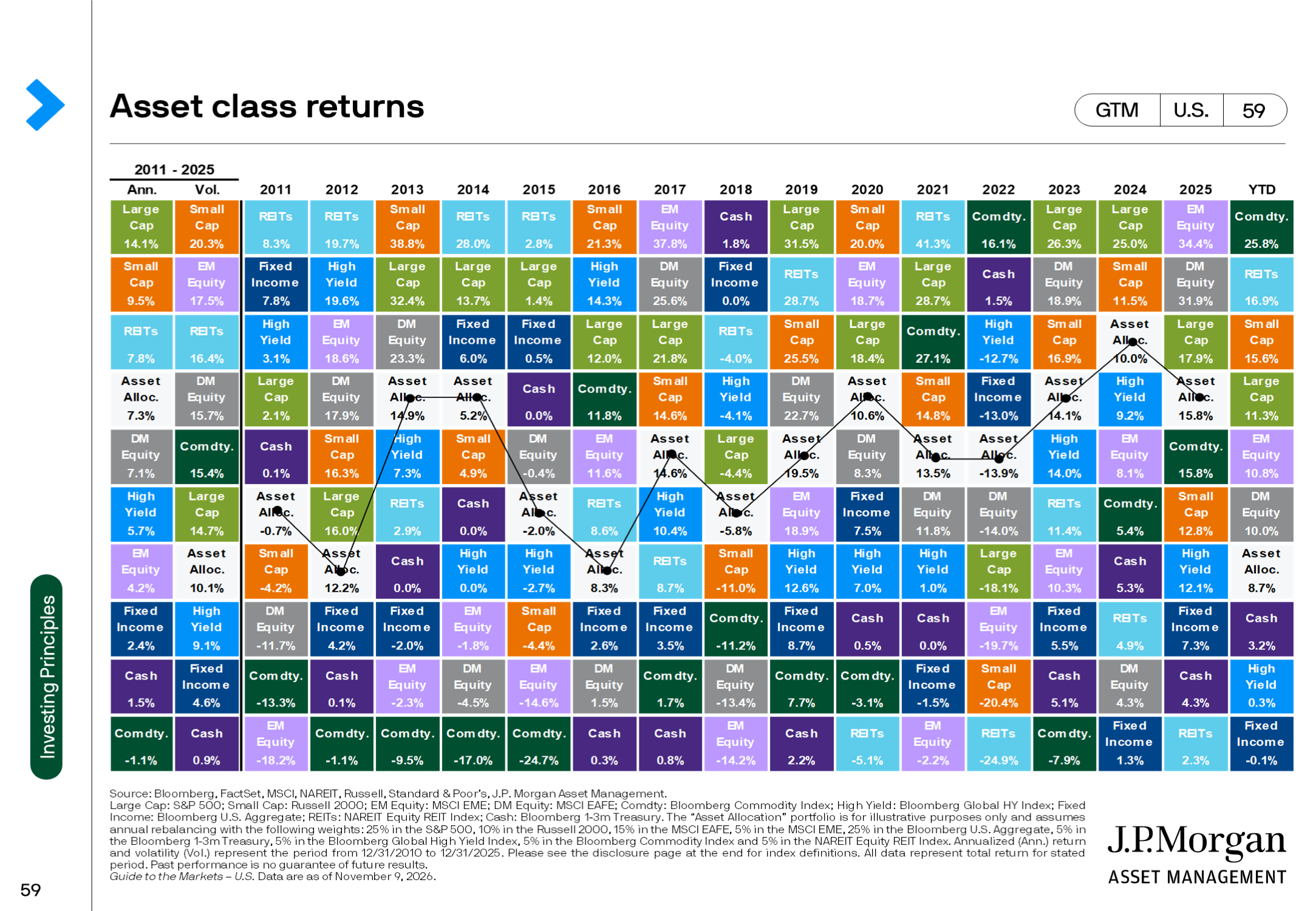
For retirees, we use a total-return approach instead of chasing high-dividend stocks or extra bond yield, so your paycheck can come from dividends, bond interest, and growth in value. In good years for stocks, we'll often fund it from the Growth Bucket. In down years, we draw from the Stability Bucket and give stocks time to recover.
Why there's usually something to draw from
This chart ranks the returns of major types of investments each year, from best to worst. You'll notice that there's historically been a favorable color to draw from, but no pattern exists to reliably predict which color will be at the top in any given year.
The Takeaway
Putting It All Together
Investing is a process. And the order deeply matters for long-term success.
These are the three questions we'll answer together:
- 1What is this money for, and when will you need it?
- 2Which risk(s) are the biggest threat to you achieving your Life Vision?
- 3Are your investments best positioned to hedge those specific risk(s)?
In the parable of the talents [Matthew 25:14–30], the servant who buried his master's money out of fear wasn't commended for playing it safe. I think faithful stewardship looks like understanding what your money is for, and then positioning it to actually do that job.
About True Riches
Why I Started True Riches
Biblically-grounded advice, tax prep included, for one flat fee.
I started my career as a CPA at Deloitte for 3 years, then spent 5 years as a Lead Advisor at a fast-growing RIA [wealth management firm]. I started True Riches in 2024 because I couldn't find anybody offering biblically-grounded advice, with tax prep integrated, for one flat fee.
True Riches is a fiduciary, fee-only practice that provides a cohesive experience across biblically-grounded financial planning, investment management, and personal tax return preparation for Christian families — all for one flat fee.

Zack Gutches, CFP®, CPA
Founder, Lead Financial Planner, & CPA